Logical thinking for kids 6–10: 12 tasks to try at home
What logical thinking is, how it shows up at ages 6–10, and 12 tasks with answers you can try at home today, sorted by age.
The DonoLand team · · 2 min read

Logical thinking is the ability to notice a rule, compare facts and reach a conclusion step by step. Children use it when they finish a pattern, work out which box holds the toy, or realise that a story doesn't add up. It isn't a talent you either have or don't: it grows with practice, and short, playful tasks are a good way to practise.
What logical thinking looks like at ages 6–10
Children this age move from simple counting to spotting rules. Typical signs: they can continue a pattern, sort things by more than one property, explain “because”, and check their own answer. Every child develops at their own pace, so use the age groups below as a guide, not a test.
Tasks for ages 6–7
- Continue the sequence: 2, 4, 6, 8, ? Answer: 10 (add 2 each time).
- Continue the sequence: 5, 10, 15, ?, 25. Answer: 20 (add 5 each time).
- Shapes: triangle, circle, triangle, circle, triangle, ? Answer: circle.
- Find the missing number: ? + 7 = 15. Answer: 8.
- Which number is even: 7, 12, 15, 9? Answer: 12 (it splits into two equal groups).
Tasks for ages 7–8
- You have 5 apples. You give 2 to a friend and then get 3 more. How many do you have? Answer: 6.
- Ali is taller than Vali, and Vali is taller than Sardor. Who is the shortest? Answer: Sardor.
- What time will it be 2 hours after 3 o'clock? Answer: 5 o'clock.
- A bird lives in a nest. A bee lives in a …? Answer: a hive.
Tasks for ages 9–10
- Continue the sequence: 3, 6, 12, 24, ? Answer: 48 (double each time).
- A bag holds 3 red balls and 2 blue balls. Without looking, how many must you take out to be sure you have two of the same colour? Answer: 3.
- I am a number. Double me, add 3, and you get 13. Who am I? Answer: 5.
How to use them: give one task at a time, wait before you help, and ask “how did you get that?” even when the answer is right. The explanation is the real exercise.
How to make it a habit
- Ten minutes a day is enough; stop while it is still fun.
- Mix tasks you are sure your child can solve with one slightly harder one.
- Use everyday moments: sorting laundry, a bus route, sharing snacks fairly.
- Praise the method (“you checked it twice”) more than the result.
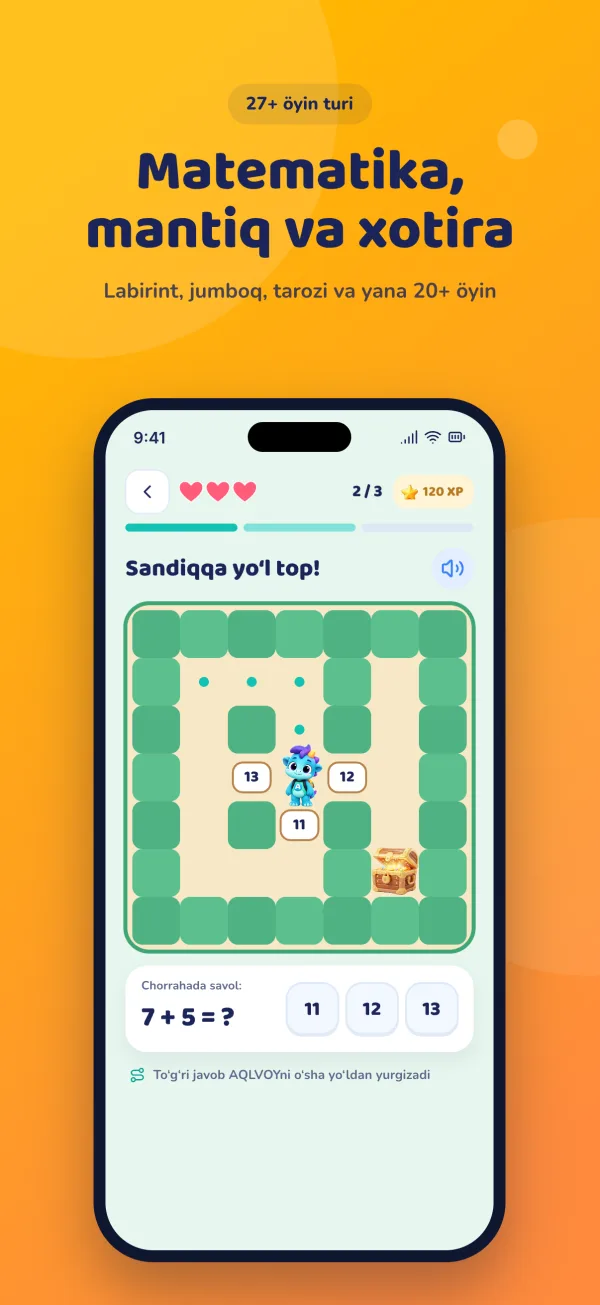
If you would like a game that practises these skills, Donoland: Aqlvoy has logic, maths and memory tasks for children aged 6–10.